01
Follicular Environment Restoration
Progenitor cells attach to and settle in shrunken hair follicles, helping to restore the size and function of the hair follicles.

OSANG SPECIALTY CENTER
HAIR FOLLICLE PROGENITOR CELL
Fundamental hair loss treatment powered by hair follicle progenitor cells
Consultation Request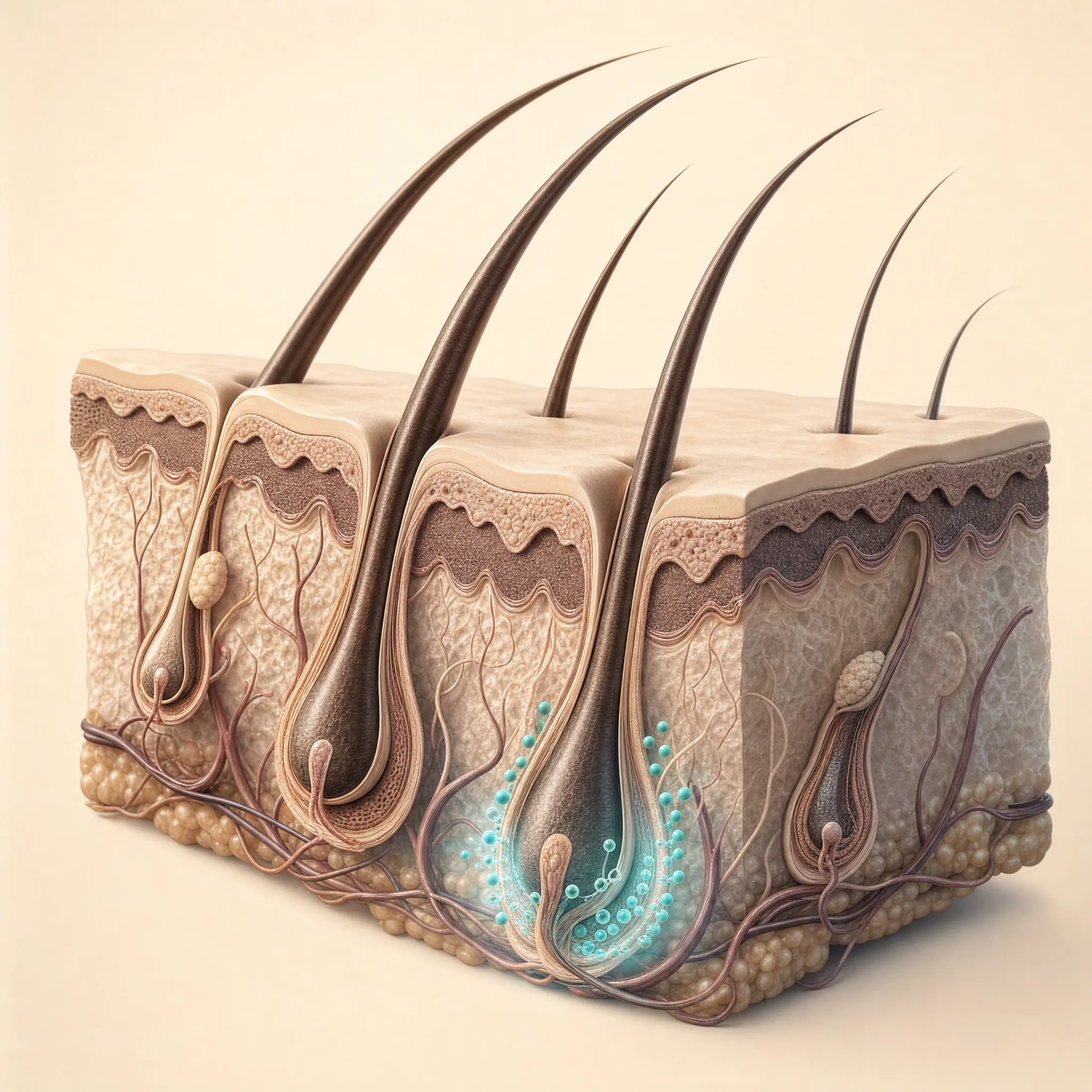
OSANG MEDICAL PROGRAM
THE PROBLEM
The earlier hair loss is detected, the more treatment options can be expanded.
Hair transplant is a surgery to harvest and transplant hair follicles from the back of the head. Hair follicle progenitor cell therapy is an approach that examines the recovery environment of weakened hair follicles themselves.
Before hair follicles completely disappear, it is important to check the current condition of the scalp and hair follicles and not miss the appropriate treatment time.
SELF CHECK
The items below are simple checks for consultation, not diagnosis.
MECHANISM
Hair follicle progenitor cells are cells involved in the growth and regeneration of hair follicles.
01
Progenitor cells attach to and settle in shrunken hair follicles, helping to restore the size and function of the hair follicles.
02
Progenitor cells differentiate into keratin cells, the material for hair, and help in the process of growing new hair.
03
It helps the shortened hair growth period return to normal flow and creates an environment in which the grown hair is maintained.
COMPARISON
TREATMENT TIMELINE
1–3 months
3–6 months
After 6 months
The timing and extent of change depends on the individual's hair loss type, hair follicle condition, and lifestyle habits.
TREATMENT PROCESS
WHY OSANG
01
At the hospital's stem cell research center, everything from cell separation to treatment is carried out in one place.
02
Instead of automatic mechanical separation, the separation process is performed directly by professional researchers.
03
Rather than just suppressing the symptoms, we also look at the recovery environment of the weakened hair follicles themselves.
FAQ
A small amount of hair follicles is collected from the patient's back of the head, and the progenitor cells are isolated in the hospital's laboratory. Separated progenitor cells are injected into the scalp where hair loss has occurred to help restore weakened hair follicles.
PRP is an indirect stimulation method using platelet concentrates, and exosomes are cell-derived vesicles. Hair follicle progenitor cell treatment directly isolates and uses cells involved in hair follicle growth and regeneration.
The entire process, from hair follicle collection to progenitor cell isolation and injection, takes approximately 2 to 3 hours.
Local anesthesia is used when collecting hair follicles from the back of the head, and fine needles are used for injections. Temporary stiffness may occur after the procedure.
Although there are individual differences, we usually check scalp health and changes in hair follicles within 1 to 3 months, new hair between 3 and 6 months, and changes in thickness and density after 6 months.
Both men and women can consider applying, and the type of hair loss and scalp condition will be diagnosed to determine whether it is suitable for you.
To determine whether concurrent treatment is possible, check the medications you are taking and your health condition and then make an individual plan through consultation with a specialist.
Hair transplant is a surgery to harvest and transplant hair follicles from the back of the head. Progenitor cell therapy is an approach that collects only a small amount of hair follicles, isolates and injects the cells, and helps restore existing hair follicles.
It varies depending on the degree of hair loss, and the number and interval of individual treatments are determined based on the diagnosis results and progress.
At the hospital's stem cell research center, a professional researcher directly isolates progenitor cells and works with a specialist to plan the procedure.
CONSULTATION
The examination and treatment plan will be explained directly by the specialist after your visit.